Beyond the Flag: How New Mexico Rebuilt the Soul of Its Child Care System
Behind the numbers, the legislative bills, and the economic data of New Mexico’s child care transformation lies a deeper, quieter truth: it is a system that finally looks child care providers and working families in the eye and says, “I see you. You matter.”
When a delegation from Washington State traveled to New Mexico, we didn’t just find an innovative administrative model. We found a system that heals the profound exhaustion, anxiety, and invisibility that child care providers and parents carry every single day. As the CEO of Kids Co., I live and breathe these daily realities – the constant balancing act of keeping care affordable for families while trying to pay living wages to a deeply dedicated workforce. To truly understand this transformation, we have to look past the surface-level branding of the state’s flag and look at the deep, systemic accountability happening underneath it. The flag features the Zia sun symbol, an ancient, sacred religious emblem belonging to the Zia Pueblo, who have cared for the land since time immemorial. In 1925, the state officially appropriated this symbol without the Pueblo’s knowledge or consent, exploiting a sacred icon while denying Native Americans the right to vote. The decades-long fight by the Zia Pueblo against this institutional theft eventually forced a massive moral and financial reckoning, establishing a new baseline of respect and restorative justice between the state and Indigenous communities.
This explicit shift from institutional exploitation to systemic accountability is exactly what Washington needs to replicate. We cannot fix our child care crisis without looking beyond the flag and directly confronting the historical inequities and cultural blind spots that currently drive our policy decisions. By examining New Mexico’s structural framework – one that deliberately dismantled institutional bias to prioritize the modern public – we can learn how to reset our own baseline, tear down bureaucratic gatekeepers, and build a system that respects every family
1. Time, Cycles, and Access: Honoring the Realities of Exhaustion
The rays of the Zia honor the continuous cycles of our world: the four directions, the four seasons, the stages of life, and the parts of a day. In child care, New Mexico applied this holistic lens to reshape how families access care and how providers are compensated.
Our current system in Washington is built on a rigid, corporate fiction that the human day begins at 9:00 AM and ends at 5:00 PM. But child care needs do not disappear when the school bell rings, when summer arrives, or when a parent works a non-traditional shift. New Mexico recognized this by building an unbreakable economic and human coalition of providers, working families, and business leaders to demand a system that respects the actual continuum of daily life:
- Year-Round, Full-Time Continuity: New Mexico funds care across the entire continuum of childhood from birth up to age 13. This stands in stark contrast to Washington State’s heavy reliance on models like ECEAP, which are largely restricted to preschool-age children and trapped in fractured, part-day, school-year-only schedules.
- True Support for Non-Traditional Hours: For parents working graveyard shifts, early mornings, or weekends, New Mexico provides percentage-based rate increases (up to 15%) to fully subsidize the operational burden of extended care. Crucially, they “delinked” a parent’s exact shift from allowable child care hours, ensuring a swing-shift worker has the state-funded care slots they need to reliably work, commute, and rest.
- Erasing the Middle-Class Squeeze: By extending free child care eligibility up to 600% of the Federal Poverty Level (FPL) and completely erasing out-of-pocket copayments, New Mexico eliminated the cruel “cliff effect.” Families saving an average of $12,000 per child annually can accept promotions and wage increases without fear of instantly losing their care infrastructure.
2. The Four Sacred Obligations: Rebuilding the System’s Broken Soul
The final element of the Zia calls us to four sacred obligations. When applied to child care, these obligations shift our mindset from managing a market to caring for human beings.
A Strong Body: Ending the Starvation Cycle
A child care system cannot remain healthy if it is starved for capital. The stark structural divide between our two states comes down to how we value this economic engine:
- Washington State: Funds child care through a volatile, general-fund operating budget ecosystem. Early learning advocates are forced to go to Olympia every year to “scrape for scraps” against healthcare, transportation, and corrections, leaving progressive revenues perpetually vulnerable to being swept or trimmed.
- New Mexico: Passed Constitutional Amendment 1, permanently anchoring its funding in the state’s multi-billion-dollar sovereign wealth fund. This legally protected foundation flows hundreds of millions of dollars annually to the early childhood department, independent of annual legislative budget fights.
A Clear Mind: Replacing Penalties with Professional Trust
True quality doesn’t come from fear; it comes from a clear mind and professional trust.
- Washington State: Washington’s administrative system heavily penalizes providers, burying them in a 200-page rulebook that treats minor administrative paperwork and arbitrary room arrangements as high-stakes licensing violations. This punitive micromanagement is a leading driver of workforce burnout.
- New Mexico: Streamlined licensing down to a 68-page book focused strictly on fundamental health and safety, completely removing subjective “quality metrics” from the threat of licensing penalties. Higher quality is celebrated and heavily incentivized through voluntary, funded pathways, giving providers the emotional and operational breathing room they need to thrive.
A Pure Spirit: Restoring Dignity to the Educator
The early childhood workforce is the workforce that makes all other work possible, yet they are routinely paid poverty-level wages. Washington continues to layer on tightening compliance and strict educational mandates, forcing underpaid teachers to take on personal debt just to keep their jobs.
New Mexico protected the “spirit” of its educators by recognizing that quality expectations must be funded simultaneously with compensation. They passed a groundbreaking Opportunity Scholarship that covers 100% of tuition and fees for early childhood degrees, paired it with mandatory salary floors, and backed it all with ongoing wage supplements. They chose to lift up the educator so the educator could lift up the child.
Devotion to the Welfare of Others: A Seat at the Table
The ultimate moral lesson of New Mexico is an unyielding commitment to the people who hold up the system. For too long, bureaucrats and institutional lobbyists have designed early learning policies in a vacuum, treating the actual workforce as an afterthought.
Standing in New Mexico, looking at the profound level of structural respect afforded to their providers, it reinforced the absolute rule we must bring back to Washington: “If providers aren’t at the table, they’re on the menu.” True equity means creating mandated frontline majorities on state regulatory boards and financially compensating independent, small providers for their time so they can afford to step away from their classrooms and co-design the system.
The Path to Reconnection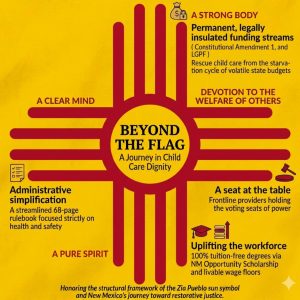
True reconnection means building a child care system designed for the actual lives families lead today, rather than forcing them to adapt to outdated bureaucratic frameworks. To do this, Washington must stop treating child care as a secondary commodity and aggressively dismantle the systemic racism and institutional biases that currently drive our policy decisions.
We must directly confront the ways our current system inadvertently excludes the very communities it claims to lift up:
- Replacing Rigid Frameworks with Community Wisdom: Washington’s current definition of “quality” disproportionately favors well-resourced, institutional programs with the administrative capital to navigate complex compliance tracking. Meanwhile, culturally grounded, bilingual, and home-based providers, the vital pillars for diverse working families, are systematically undervalued and pushed into lower funding tiers. We must evolve beyond rigid registries like MERIT, and instead structurally value localized expertise and community-based wisdom.
- Bridging the Capital Divide in Under-Resourced Communities: Decades of historical banking and neighborhood disparities mean that localized providers frequently operate facilities in under-resourced areas with aging infrastructure. Merely raising daily subsidy rates does not solve a provider’s inability to secure commercial loans for major facility improvements. Washington must prioritize direct capital infrastructure grants to these communities, correcting long-standing economic disparities at the foundational level.
- Eliminating Bureaucratic Gatekeepers: Complex, English-centric state compliance portals leave immigrant, refugee, and diverse communities “eligible but excluded.” We must design our state bureaucracy to bend to the multilingual, fluid realities of the working public, ensuring that administrative language is used as a bridge to access, never a barrier.
Restoring the soul of our child care system isn’t just a task for lawmakers; it requires the collective voice of everyone who relies on it. Like the four rays of the Zia sun, we must realize that every family, every business leader, and every provider are bound together in this work.
As someone leading Kids Co. through these exact challenges, I want to hear from you: What is the one change that would bring you or the providers in your own community the most immediate sense of relief and professional dignity?
Resources: