When Transparency Becomes a Weapon: Why Child Care Provider Safety Must Come First
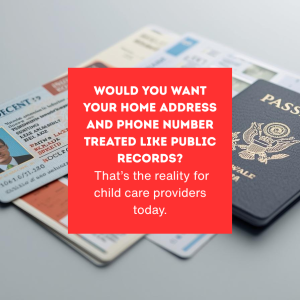
Privacy is safety. Child care providers don’t have either.
Child Care Providers Are Being Put at Risk
Child care providers should never have to fear for their personal safety because they care for children. Yet over the past year, many providers in Washington State have experienced exactly that.
Beginning in May 2025, child care providers raised serious concerns after discovering that public records requests had released their personally identifiable information – home addresses, phone numbers, and other sensitive data. As required by state law, providers must enter this information into the Department of Children, Youth, and Families’ (DCYF) MERIT system. However, unlike family home child care providers, center-based child care workers do not have statutory protections to keep this information private.
When Personal Information Becomes Public
As a result, the consequences were immediate and deeply unsettling. Complete strangers began showing up unannounced at providers’ private homes from people who knew their names, addresses, and profession. In addition, others received propaganda mailers and unsolicited text messages on personal cell phones.
Consequently, for providers – many of whom are women, immigrants, and people of color – these incidents created fear, stress, and a profound sense of vulnerability in what should be the safest place: home.
In response, providers sought answers directly from DCYF leadership. DCYF explained that public records requests made under Washington’s Public Records Act had triggered the disclosures. While transparency in government matters, releasing individual workers’ personal information without safeguards nevertheless creates a clear and present safety risk.
A Narrow, Common-Sense Fix
Given these risks, providers, advocates, and policymakers worked collaboratively to address the gap. Accordingly, on December 22, 2025, Senator Lisa Wellman prefiled SB 5926. The bill took a narrow and straightforward approach: it amended existing statute to extend Public Records Act privacy protections – already afforded to family home providers – to all child care workers.
Importantly, SB 5926 did not shield child care businesses from oversight. Nor did it restrict access to licensing, compliance, or enforcement information. Instead, it protected only the personally identifiable information of individual workers.
Disinformation, Racialized Fear, and Escalating Threats
However, what followed was not a policy disagreement. Rather, disinformation and racialized fear drove the response.
On December 31, 2025, federal officials notified Minnesota that the state would lose federal child care funding due to documented fraud at the state level and among some providers. Shortly thereafter, bad actors distorted and weaponized that news in Washington State. Specifically, they falsely portrayed SB 5926 as an effort to “hide fraud,” despite the bill’s plain language.
Moreover, political actors and social media accounts amplified these false claims. As a result, racist and anti-Somali rhetoric surged. Subsequently, Somali child care providers in Washington State began receiving harassment and death threats. At the same time, Senate staff warned that hearings on SB 5926 would require increased security because of the volume and severity of threats connected to the bill.
A Bill Pulled Because It Was Too Dangerous to Advance
By January 7, 2026, legislative leaders asked Senator Wellman to pull the bill from consideration. The issue had become too volatile. Providers and legislators were facing credible threats of bodily harm.
Furthermore, subsequent conversations with House leadership confirmed the reality: despite interest in addressing the problem, lawmakers would not advance the bill during the session because of safety concerns and insufficient bipartisan support.
The Result: Transparency Weaponized
The result is stark and unacceptable.
Washington did not witness transparency in action. Instead, the state witnessed transparency weaponized. When public systems expose individual workers’ personal information without safeguards – and when disinformation exploits racialized narratives for political gain – the outcome is not accountability. Rather, it is harm.
Today, child care workers remain unprotected. Their personal information remains publicly accessible. Meanwhile, immigrant providers and providers of color continue to bear the greatest risk when bad actors exploit state systems to intimidate and terrorize.
Notably, this moment does not exist in a vacuum. For decades, racialized narratives about “fraud,” “quality,” and “accountability” have justified heightened surveillance of Black and brown workers. When those narratives collide with public disclosure systems, they consequently create real and measurable safety risks for child care providers.
Safety Must Come First
Child care is essential infrastructure. Therefore, the people who provide it deserve the same basic safety protections as others who serve the public good.
Protecting child care workers’ personally identifiable information is not about hiding wrongdoing. Instead, it is about preventing harm.
Until Washington State closes this gap, it chooses exposure over safety and asks essential workers to shoulder the risk.
That choice must change – now.