
Celebrating AANHPI Heritage Month: Honoring a Legacy of Leadership and Resilience in Seattle
History is not just something we learn, it is something we live, breathe, and build every day. This Asian American and Native Hawaiian Pacific Islander (AANHPI) Heritage Month, we are celebrating the theme “A Legacy of Leadership and Resilience.”
Learning about the contributions of AANHPI leaders is essential for young learners. When kids see diverse leaders reflected in their community’s history, they are empowered to imagine themselves as future changemakers. Celebrating AANHPI stories nurtures respect, empathy, and a deeper understanding of the world we share.
Today, we are proud to highlight five individuals whose leadership, advocacy, and creativity have shaped the city of Seattle into the vibrant place we know today.

Bob Santos: Champion for Seattle’s Chinatown International District
Bob Santos, affectionately known throughout Seattle as “Uncle Bob,” was a beloved community leader and activist who spent decades shaping the city’s Chinatown International District. As a fourth-generation Filipino American, Bob used his deep roots and unwavering commitment to protect the neighborhood from displacement and neglect during the 1970s and beyond.
As Executive Director of InterIm Community Development Association, he helped transform the International District from a neglected area into a vibrant, livable neighborhood for Asian American elders, families, and workers. His work was about more than buildings, it was about protecting cultural identity and community belonging.
He was also one of the “Gang of Four,” a multiracial alliance of activists who joined forces to fight for racial equity, low-income housing, and social justice in Seattle.
In 2016, the Seattle City Council honored his legacy by renaming the stretch of South King Street between Fifth and Sixth Avenues as “Uncle Bob’s Place”.
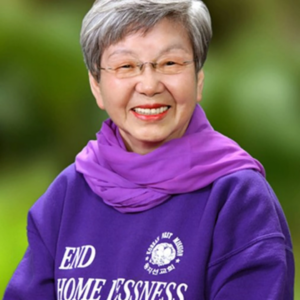
Rev. Jean Kim: Tireless Advocate for the Unhoused
Rev. Jean Kim was a fierce advocate, a compassionate pastor, and a lifelong fighter for those who often felt unseen. In Seattle, she became a powerful voice for people experiencing homelessness, dedicating her life to creating hope and opportunities for those most in need.
For nearly two decades, Rev. Kim donned the same outfit whenever she worked, preached, or marched — a purple shirt boldly printed with the words “End Homelessness for All People.” It was more than a slogan. It was her personal mission, a visible reminder of the work she believed must never stop.
Rev. Kim was also a passionate learner. She earned four master’s degrees during her lifetime, believing that education was a vital key to empowerment, both for herself and for those she served. She used her knowledge to found organizations, advocate for housing policies, and create programs that helped people gain access to education, jobs, and stable homes.
Those who knew her often called her a “mother to the unhoused,” not because of charity, but because of the way she built community through love, respect, and relentless advocacy.

Carlos Bulosan: The Storyteller Who Spoke for the Unseen
Carlos Bulosan was a Filipino American writer, poet, and activist who used his voice to speak for those who were often unheard. Arriving in Seattle in 1930 during a time of deep racism and economic hardship, he experienced discrimination and poverty firsthand. These struggles shaped his writing and fueled his lifelong fight for justice.
His most well-known book, America Is in the Heart, is a semi-autobiographical novel that gives readers a powerful look at the lives of Filipino laborers and immigrants in the United States. It tells the story of a young man searching for dignity and equality while working on farms, canneries, and cities across the West Coast.
Bulosan’s words strengthened the labor movement and inspired generations of Filipino Americans to stand up for their rights. Through storytelling, he captured the pain and resilience of his community, reminding readers that America’s promise should include everyone.

Joseph Kekuku: The Musician Who Brought the Sound of Aloha to the World
Joseph Kekuku was a Hawaiian musician and inventor whose creativity forever changed the world of music. Growing up in Laie, Hawaii, Kekuku discovered a new way of playing guitar by sliding a metal object across the strings. This technique led to the creation of the Hawaiian steel guitar, an innovation that produced a rich, expressive sound unlike anything people had heard before.
Kekuku’s invention traveled far beyond Hawaii. He toured across the mainland United States and even Europe, sharing the beauty of Hawaiian music with audiences everywhere. His performances sparked a global love for the warm, soulful sounds of the steel guitar, influencing many styles of music from country to blues.
Although Joseph Kekuku passed away in 1932, his musical legacy lives on. Today, the steel guitar remains a symbol of cultural pride and creative spirit, thanks to the young boy from Hawaii who dared to experiment and follow his imagination.

Goon Dip: A Bridge Builder Between Communities
Goon Dip was a Chinese American businessman, labor contractor, and diplomat whose efforts helped lay the foundations for Seattle’s Chinatown International District. Born around 1862 in Guangdong Province, China, Goon immigrated to the United States and started working as a houseboy and laborer in Portland. Over time, he built a successful career as a merchant and labor contractor for riverboat and cannery workers across the Pacific Northwest, a rare accomplishment during a period marked by harsh anti-Asian discrimination, including the Chinese Exclusion Act of 1882.
His influence grew not just in business but also in diplomacy. In 1909, the Chinese government appointed him honorary consul to represent the Chinese community during Seattle’s Alaska-Yukon-Pacific Exposition.
Goon Dip played a critical role in rebuilding the Chinese community after the Jackson Street Regrade between 1907 and 1910, when much of Seattle’s original Chinatown was demolished. Recognizing the urgent need for a new community hub, he organized the Kong Yick Investment Company, bringing together 170 Chinese American investors. With no support from banks, they financed and built the East and West Kong Yick Buildings, which became vital centers of commerce, housing, and culture.
Today, the East Kong Yick Building houses the Wing Luke Museum, preserving the stories and history that Goon Dip and others helped create. His legacy even stretches beyond Seattle as Mount Goon Dip in Alaska is named in his honor, a lasting reminder of his impact across the Pacific Northwest.
When children learn about leaders like Bob Santos, Rev. Jean Kim, Goon Dip, Carlos Bulosan, and Joseph Kekuku, they do more than memorize history. They learn values of courage, creativity, resilience, and empathy.
Learning about AANHPI culture and heritage helps kids:
- See leadership in many forms, from activism to storytelling to creative innovation
- Build empathy for others’ experiences and struggles
- Understand that their own ideas, identities, and dreams are vital to their community
At Kids Co., we are committed to helping every child discover their own role in building a more inclusive and inspiring world.
Happy AANHPI Heritage Month from all of us at Kids Co.
Sources:
Wikipedia – Bob Santos (activist)
HistoryLink.org – Bob Santos Biography
The Seattle Times – Rev. Jean Kim obituary
You Might Also Like Reading:
Honoring Seattle’s Influential Black Leaders
African American Heroes in Education
Embracing Heritage: Celebrating Native American Heritage Month as a Family